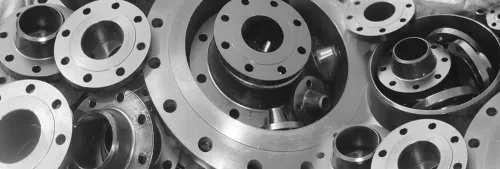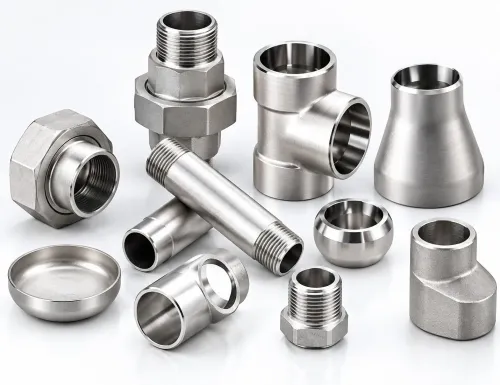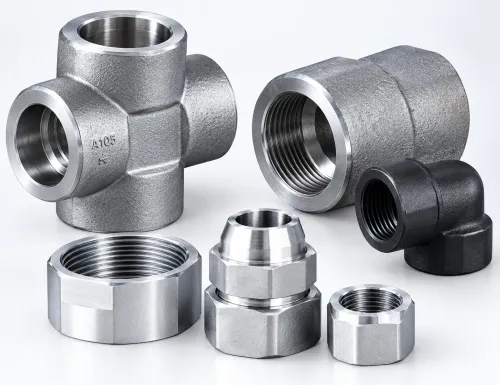
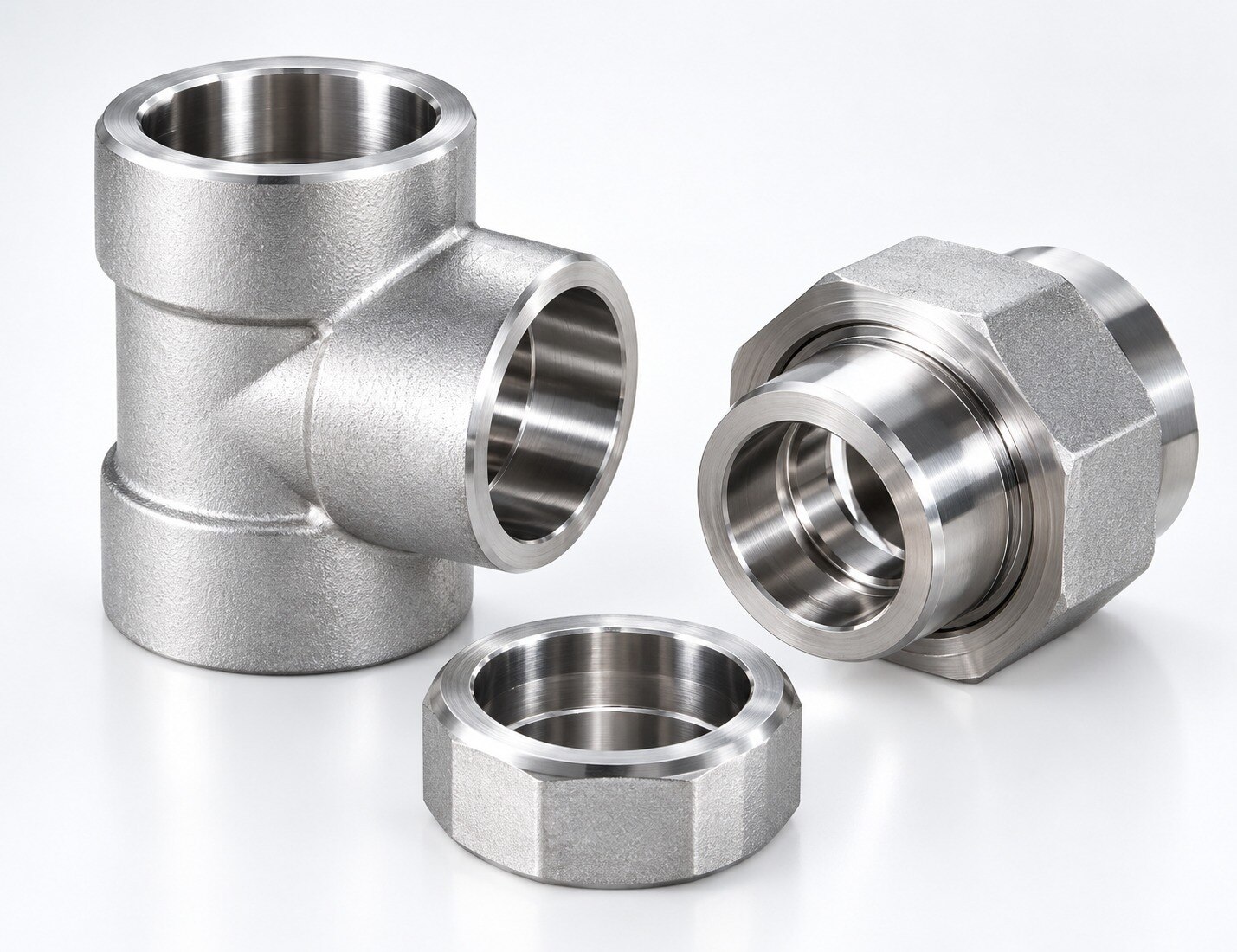
A socket-weld flange is welded to the pipe itself; it is not normally a flange that connects directly to a separate socket-weld elbow, tee, or coupling. The correct arrangement depends on bore, pressure class, temperature, cyclic loading, facing, gasket, inspection access, and Mumbai’s coastal exposure, and the sections below give you a specification and installation checklist.
Key takeaways
- Connect the flange to pipe, not directly to a socket-weld elbow or tee.
- Leave approximately 1.5 mm of expansion gap before applying the fillet weld.
- Match flange size, pressure class, bore, material, facing, and ASME standard.
- Use compatible gaskets, bolting, coatings, and inspection controls for Mumbai conditions.
How a socket-weld flange fits into a process-plant piping assembly
A socket-weld flange connects to the pipe, not normally directly to a socket-weld elbow, tee, or coupling. Insert the pipe into the flange’s integral socket, withdraw it approximately 1.5 mm from the shoulder, align the joint, and apply the specified fillet weld.
The socket-weld fitting connects elsewhere in the run, with pipe between the fitting and flange.
The flange then bolts to a matching flange on a valve, vessel nozzle, or adjoining pipe. That bolted joint uses a gasket; the socket weld is the permanent pipe-to-flange connection.
| Type | Pipe connection | Main difference |
|---|---|---|
| Socket-weld flange | Pipe enters a socket and receives a fillet weld | Compact small-bore arrangement; the flange does not accept a separate socket-weld fitting |
| Slip-on flange | Pipe passes through the flange and is fillet-welded | Easier to position, but uses fillet welds around the pipe rather than a socket shoulder |
| Weld-neck flange | Pipe is butt-welded to the tapered hub | Better stress transition and inspection access for demanding or larger lines |
| Threaded flange | Internal threads engage threaded pipe | No welding at the flange; unsuitable where vibration, leakage, or temperature threatens the threads |
| Blind flange | No pipe bore; bolts across an open flange | Closes a line or nozzle rather than connecting pipe |
When selecting flanges for socketweld fittings in socketweld fittings process plants, do not match names alone. Check ASME B16.5 flange dimensions and ratings against ASME B16.11 fitting data, while confirming pipe outside diameter, wall thickness, material, temperature, and the applicable qualified welding procedure.
When a socket-weld flange is suitable—and when to choose a weld neck
Choose a socket-weld flange when the line is small-bore, the ASME B16.5 tables list the required size and class, and the service does not require pigging, full-bore flow, or frequent solids cleaning. For applications in process plants in Mumbai, this compact arrangement can reduce fabrication space without justifying a larger weld-neck assembly.
| Option | Use it when | Reject it when |
|---|---|---|
| Socket-weld flange | Small-bore, high-pressure, clean service with limited thermal cycling | The internal shoulder could trap solids, restrict drainage, or complicate inspection |
| Weld-neck flange | The line has cyclic loading, thermal expansion, larger bore, or demanding radiography access | Space and fabrication simplicity matter more than fatigue resistance |
| Butt-welded connection | You need a near-full-bore passage, low turbulence, pigging, or easier volumetric examination | The small line does not justify more preparation and welding time |
A weld neck earns its extra cost when the pipe wall, flange hub, and smooth bore must carry repeated thermal or mechanical loads. Its butt weld also gives inspectors a more accessible weld profile than the fillet weld on a socket-weld flange.
Check availability before designing around socket welding: B16.5 does not provide this flange type in every nominal size and pressure class.
Do not match a B16.11 socketweld fitting Class 3000, 6000, or 9000 directly to a B16.5 flange Class 300, 600, or 900; the piping specification must reconcile pressure-temperature rating, pipe schedule, bore, material, gasket, bolts, and valve.
Use the socket-weld option only when a qualified welding procedure and examination plan control the joint. Otherwise, choose a weld-neck or butt-welded arrangement that gives the project better inspection and service-life margins.
How to match size, rating, bore, material, and standard
Approve the combination only when the flange, pipe, socket-weld fitting, gasket, bolts, and valve match the piping class at the design temperature. A nominal size alone is not enough: verify the pipe’s actual outside diameter, wall thickness, schedule, socket bore, and corrosion allowance.
| Check | What must match | What can disqualify it |
|---|---|---|
| Size and bore | Nominal pipe size, actual outside diameter, wall thickness, and flange bore | The pipe will not enter the socket correctly, or the bore creates an unacceptable restriction |
| Rating and temperature | ASME B16.5 flange Class 150, 300, 400, 600, 900, 1500, or 2500, with the required pressure-temperature rating | Treating a Class 600 flange as equivalent to a Class 6000 fitting |
| Fitting class | ASME B16.11 Class 3000, 6000, or 9000, checked against pipe wall and plant piping class | Approving the fitting class without checking the complete pressure boundary |
| Material | Matching material specification, grade, weldability, corrosion allowance, and service temperature | Dissimilar materials or a welding procedure that does not qualify the joint |
| Standard and facing | ASME B16.5 dimensions, tolerances, marking, testing, and the specified raised-face, flat-face, or ring-type face | A supplier offers an unlisted size, class, or facing |
ASME B16.5 governs the flange; ASME B16.11 governs the forged fitting. Flanges for socketweld fittings are not available in every B16.5 size and class, so check the tables before approval. Industrial flanges in Mumbai follow the plant code, not the city; Mumbai controls more of the storage, inspection, and corrosion documentation.
The socket-welding sequence and the expansion gap installers must preserve
Leave about 1/16 inch (1.6 mm) between the pipe end and socket shoulder; do not weld with the pipe hard against the bottom. Thermal expansion during welding needs room, or restraint at the shoulder can initiate cracking.
- Cut the pipe square, remove burrs, and clean the bore, socket, and outside surface. Check the actual pipe outside diameter and wall against the fitting dimensions.
- Insert the pipe fully to the shoulder, mark that position, then withdraw it approximately 1.6 mm. Measure the gap with a depth gauge or a marked reference, not by eye.
- Align the pipe and flange face before tack welding. Keep the pipe concentric, preserve bolt-hole orientation, and prevent the gap from closing during tacking.
- Apply the specified fillet weld around the complete socket entrance. Use the qualified procedure’s filler metal, preheat, interpass-temperature limit, travel sequence, and weld size; never bridge a visible misalignment by adding uncontrolled weld metal.
- Remove slag and spatter, then examine the finished weld. Perform visual examination and any liquid-penetrant, radiographic, or ultrasonic examination required by the project specification and governing piping code.
Socketweld fittings in process plants must be installed by welders qualified for the process and material. Require a welding procedure qualified under ASME Section IX, with heat treatment and examination records where specified; a dimensional certificate for the flange or fitting does not qualify site welding.
A failed shoulder weld needs repair under an approved procedure, not a second pass over the defect.
How facing, gaskets, bolting, and Mumbai corrosion controls complete the joint
Make the joint leak-tight by treating the flange face, gasket, and bolting as one engineered system. Match the facing geometry to the gasket specified in the piping class; do not draw a flat-face component against a raised-face flange unless the joint design permits it.
Clean both faces, centre the gasket without blocking the bore, and tighten in a cross-pattern with a calibrated, controlled procedure.
There is no universal torque value. Gasket construction, bolt diameter and grade, lubrication, flange flexibility, and target bolt stress determine the tightening method. A copied torque table can crush the gasket, leave a leak path, or overload the flange.
For industrial flanges in Mumbai, specify controls for salt-laden air and monsoon wetting:
- Coat or paint carbon-steel flanges as the project specification requires.
- Protect exposed nuts and bolts against water entry and crevice corrosion.
- Seal and weatherproof insulated flange boxes.
- Provide drainage so water cannot remain beneath insulation or at the flange gap.
- Select materials for chloride pitting and crevice exposure; “stainless” alone is not a corrosion specification.
Ask Nexus Forge Industries for a complete document pack containing the ASME B16.5 or B16.11 compliance statement, material test certificates, dimensional and pressure-test records, gasket and bolt details, coating records, and traceable markings.
For a flanges socketweld fitting for applications in process plants in Mumbai, also demand the approved WPS, PQR, welder qualifications, and required weld-examination reports.
Related service
SOCKETWELD FITTINGS Socket Weld Fittings Manufacturer & Supplier – Nexus Forge Industries Nexus Forge Industries is a trusted manufacturer and supplier of high-quality... View service → |
Frequently asked questions
How does a socket-weld flange fit into a process-plant piping assembly?
Insert the pipe into the flange’s integral socket, withdraw it approximately 1.5 mm from the shoulder, align the joint, and apply the specified fillet weld. The flange normally connects to pipe rather than directly to a socket-weld elbow, tee, or coupling.
When should you choose a socket-weld flange instead of a weld-neck flange?
Choose a socket-weld flange for suitable smaller-bore, high-pressure services where access and installation make a socket connection practical. Choose a weld-neck flange when cyclic loading, thermal expansion, high stress, or fatigue resistance makes the tapered butt-weld design more suitable.
How do you match a socket-weld flange to the piping system?
Confirm nominal pipe size, pressure class, bore, flange facing, material grade, temperature and pressure design conditions, and the governing standard. ASME B16.5 covers many flanges through NPS 24; verify the project specification and material standard before ordering.
What expansion gap must installers preserve during socket welding?
Withdraw the pipe approximately 1.5 mm from the socket shoulder before welding. This gap allows thermal expansion during welding and helps prevent excessive stress at the flange.
Which gasket, bolting, and corrosion controls complete the joint in Mumbai?
Match the gasket to the fluid, temperature, pressure, and flange facing; select bolting compatible with the design temperature and corrosion environment; and control Mumbai’s humid, chloride-bearing conditions through suitable material selection, surface protection, storage, and inspection.